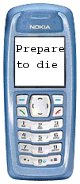
 |
| Do you really want to know? | |
We all hate the co-worker who brags about 'getting away from it all' on his
holiday - going to that beach resort which is so remote that it doesn't even
have mobile phone coverage, and who insists that telephone communication is
only available 'if it's life or death'. Attractive as that proposition is, it's
a sentiment that might kill you. Western governments are falling over themselves to supply an early
warning tsunami system. Details are sketchy, but the reality is that this
doesn't take much more than some seismographs, some crude oceanographic
modeling and, the bane of the post-modernist techophobe, SMS. But before proclaiming 'the gummint must do something', let's consider
whether private enterprise could handle this perfectly well. Leftists and other fans of all-powerful government may be outraged at the
suggestion that such a warning system should have nothing to do with government
- after all isn't that what government is for? Outraged people are rarely
rational, and Leftists are no exception. It wouldn't have been too hard for a seismologist and an oceanographer to
get together and predict that a magnitude 9.0 earthquake off Sumatra would
cause waves that would kill people in several busted-arsed third-world
countries. And there is nothing stopping people from subscribing to an earthquake
reporting service via SMS. Such a service could report the magnitude and
location of all significant earthquakes around the globe, predict tsunami
strength, location and arrival time, and then SMS anyone who subscribed to the
service, almost immediately. "But we can't trust private enterprise" the leftists will scream
"the greedy private company won't actually have the incentive (or possibly
even the ability) to give timely warnings of an imminent catastrophe and it
would take people's money for nothing (unlike governments which are always
pinnacles of honesty and efficiency)". Get real. People could easily judge
the quality of the service by judging the timeliness (and correctness) of the
low level warnings. The occasional "EARTHQUAKE OFF SIBERIA STRENGTH 3.3
TSUNAMI WAVES 0.03m DANGER NIL" would provide a very good periodic check
of the effectiveness and timeliness of the service. There would of course be freeloaders - people who rely on someone else's
phone warning of the coming tsunami, and rely on their good will to pass
on the warning instead of muttering something about a sudden interest in
mountain climbing and bolting for the nearest hill, but so what? People could
make their own decisions. Anyone genuinely concerned about tsunamis could
subscribe to the service, while others could choose to take their chances. Of
course it would only take one SMSed beach-goer to warn a whole crowd. In fact there are any number of companies who would jump at the chance to
supply this service for nothing just for the sponsorship. Broadcasting
"THIS INFORMATION BROUGHT TO YOU BY PHILIP MORRIS BECAUSE WE WANT TO KEEP
YOU ALIVE" is something that a certain cigarette company would kill
for. Come to think of it, they probably already have. Not content with private sector solutions, governments generally like the
idea of a government hook into the SMS function on everybody's mobile phone -
including our very own Little Johnny. He will control the messages that we
receive, and the manner in which we receive them. Regardless of which solution succeeds, those people who want to 'get away
from it all' might think twice before leaving their mobile phones at
home. Wearing the electronic leash might be tiresome, but much like an infant
is comforted by being swaddled, the bonds of slavery can comfort the slave. Who needs an ID card when you have mobile phone?
|